| Music compose editor software |

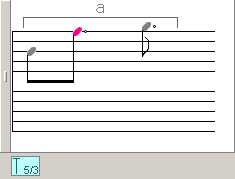
Compose music examples.EXAMPLE 1.Table of Contents Previous NextAt first you have to define key, motive type, meter and the melody structure. It helps to create the 'New' Dialog. The melody that we create has E-major tonality. The motive type is choree. Our melody has the most typical structure: a period consisting of two sentences. Each sentence consists of two phrases, each phrase consists of two motives. The melody meter is 2/4. Each melody develops out of several main motives. As usual, these motives are at the beginning of a melody. If a melody has no off-beat, it starts usually with a tonic triad, that tunes a listener to the chosen key. There are two ways for motive creation. The fist way is based on the chosen chord. I.e. you fist choose a chord and compose a motive on its basis. If the motive being edited contains the chords then the Motive Editor prompts how and when to resolve the non-chord tones. The non-chord notes enrich the intonation context of a melody. Another way is to compose the motive notes and match a chord for them. To compose the first motive we use the first way. I.e. we will base on the chosen chord as we compose. The composed motive is shown on Figure 1. Let's call it 'a'.
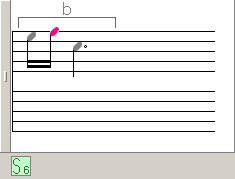
To compose the second motive and complete the phrase you must use methods of motive development. There are two main methods: repeat a motive and 'compare' with another motive. Firstly we choose a chord for the second motive, in our case S6. This is subdominant. In the first sentence as we choose the chords we follow the base scheme of harmonic progression T-S-D-T. Then with the help of Motive Editor we compose the new motive. It has to be a contrast to the first motive. On Figure 2 you can see the composed motive. As it's a contrast to the first one, let's call it 'b'. The second motive rhythm is a contrast to the first motive rhythm. The first motive rhythm consists of three close durations. The second motive rhythm, which more dynamic at the beginning, stops on a long duration at the end. This duration marks the composed phrase, separates it from the next phrase and thus makes a caesura.
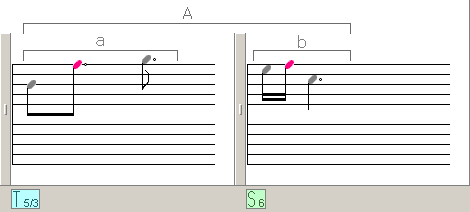
The first phrase is shown on Figure 3. As you can see, the phrase is an ascending wave. It's typical for a melody to develop like a wave. A phrase has to sound as a whole, it has to be easily defined orally. This phrase fits this definition. Let�s call the first phrase A.
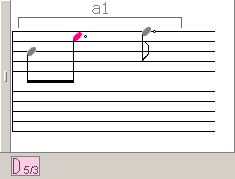
There is the quotation from 'Sentence. Cadence. Periood.': "One or more motives-cores are placed at the beginning of a melody. Such motives define the further melody character. Then the motive developed from first one is placed. Then the next motive developed from any previous motive follows. And so on. Thus a melody is the result of motives development." The same rule is true for phrases. Following the rule described above, to compose the first motive of the second phrase we use the first motive of the first phrase. We just repeat it but in the new chord context � the new motive notes are transposed in accordance with the new chord. Choosing the chords in the first sentence we follow the scheme T-S-D-T. For our motive we choose the dominant chord D5/3. We use 'Repeat' method to create new motive. This method just repeats the original motive but in the new D5/3 chord context. As the new motive is developed from the motive 'a' let's call it 'a1'. You can see it on Figure 4.
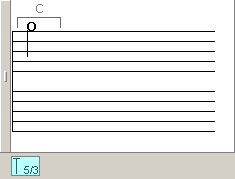
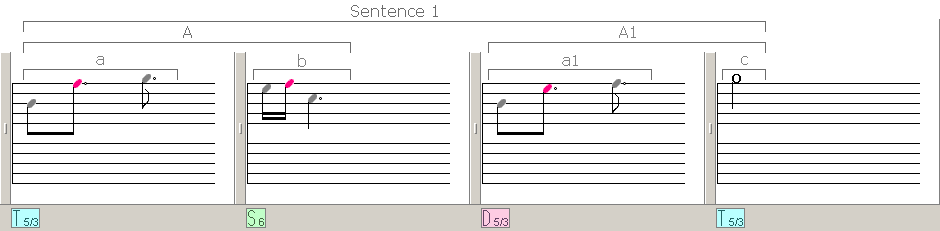
Sentence in the 'music speech' consists of 2-3 phrases, divided by caesura (comma). Cadence is the end of a sentence, it's similar to a point or a question mark in the common speech. In our case sentence consists of two phrases. The fourth motive implements a melodic and harmonic cadence. The half melodic cadence usually realizes by a long unstable note. In our case it's a half duration and the relatively stable third scale degree, which strives to resolve into the tonic. You may compare our melodic cadence with a question mark. The answer is the end of the second sentence, that ends on the tonic. The tonic in the scale has a function of stability. The first sentence harmonic cadence is non-typical. Usually the first sentence ends on the dominant chord. In our case it's T5/3, which is more typical for the concluding cadence at the last sentence end. The fourth motive is incomplete � it contains only one note. Let's call this motive 'c' (see Figure 5).
The second phrase begins with motive developed from the first motive of the first phrase. The second phrase is like the first but emphasize the end of the phrase which also is the end of the sentence. So let�s call this phrase A1 (see Figure 6).
The first sentence is shown on Figure 7.
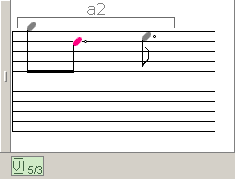
Following the rule that a melody is a continuous sequence of the motive development, to compose the first motive of the third phrase we use the first motive 'a' of the first phrase again. We use both ways of the motive development. Firstly we sequence the motive 'a' up and then partially inverse it. The new sentence may start with any chord, despite of the previous sentence last chord. The new sentence starts a new music idea even on the harmonic level. Let�s build a new sentence with the triad built from the sixth scale degree. Let�s call the new motive 'a2' as it�s developed from the motive 'a' (see Figure 8).
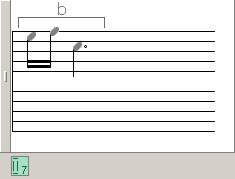
To compose the second motive of the third phrase continue to use the motives previously created. Let's take the motive 'b' (the second motive of the first phrase) as the original motive. Use the exact repeating but with a new chord, the seventh chord from the second scale degree. As we use the exact repeating, we don�t create the new motive, so let�s call it also 'b' (see Figure 9).
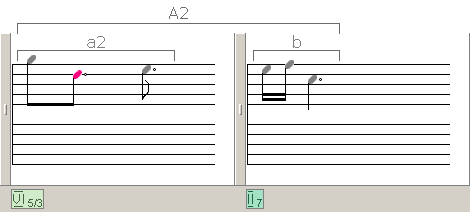
The third phrase is shown on Figure 10. It's also developed from the first phrase A, so let's call it A2.
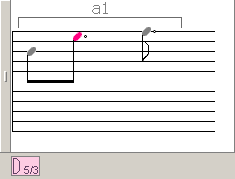
To create the fourth phrase take the second phrase A1 as the original phrase. Firstly just repeat the motive 'a1' (the first motive of the second phrase) with the same chord D5/3 (see Figure 11).
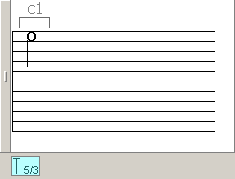
The second motive in the fourth phrase is the last motive of the sentence and the period. The last sentence ends by the full melodic and harmonic cadence. The full concluding cadence is often implemented by the tonic with the long duration on the up-beat. We do it in our motive. We leave the long duration on the up-beat from the motive �c� (the second motive of the second phrase). Take the note E � tonic in E-dur � as a pitch. You may compare the full melodic cadence with a point. Thus we finish the melodic development of our period. The second sentence is the answer for the question in the first sentence (unstable half cadence). The full harmonic concluding cadence is implemented by the chord T5/3. Transition D5/3-T5/3 in the concluding cadence is a typical harmonic end of a period. The sharp unstable D5/3 accents the stability of the tonic T5/3 that is the harmonic end of the our melody. Let�s call the last motive 'c1' as it's developed from the motive 'c'. The second motive of the fourth phrase is shown on Figure 12.
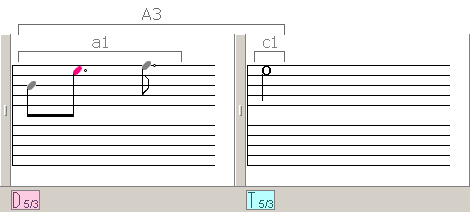
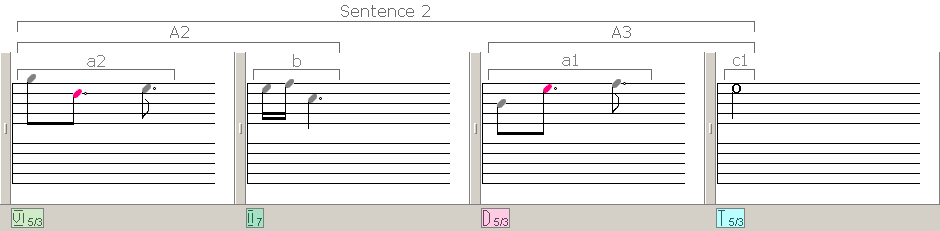
The fourth phrase is shown on Figure 13. As it's a almost repeating of the phrase A1 developed from the phrase A let's call it A3.
The second sentence is shown on Figure 14.
Composed period is shown on Figure 15.
Scheme of the composed melody is �1-�2-�3-�4. This is scheme is not often used. To create a melody with a more wide and free motion use the following schemes:
Table of Contents
Previous
Next Copyright (c) 2003 - 2005 Ilya Schepikhin. All rights reserved. |
||||||||||||||||||||||||||||||||||||||||||||||||||||||||||||